Monday, 24 August 2020

News from the school

It is coming towards what should have been the last term of the school year in South Sudan.  However, there has been no move as yet towards opening schools in spite of much pressure from citizens across the country as well as the international community.  It seems likely that we will not now reopen until January, which is the beginning of the new school year. 

At a recent meeting of the Technical Working Group on Covid-19, which comprises all Health NGOs working in Nimule, including big players such as the World Health Organisation and the Red Cross as well as local NGOs and health officials, it was decided to form an Education Sub-Committee to look into ways to support schools in the Nimule area so that they are ready to reopen with precautions against Covid-19 and also to advise them on how to keep staff and children safer.  I will be taking part in this sub-committee. 

The Need for Desks

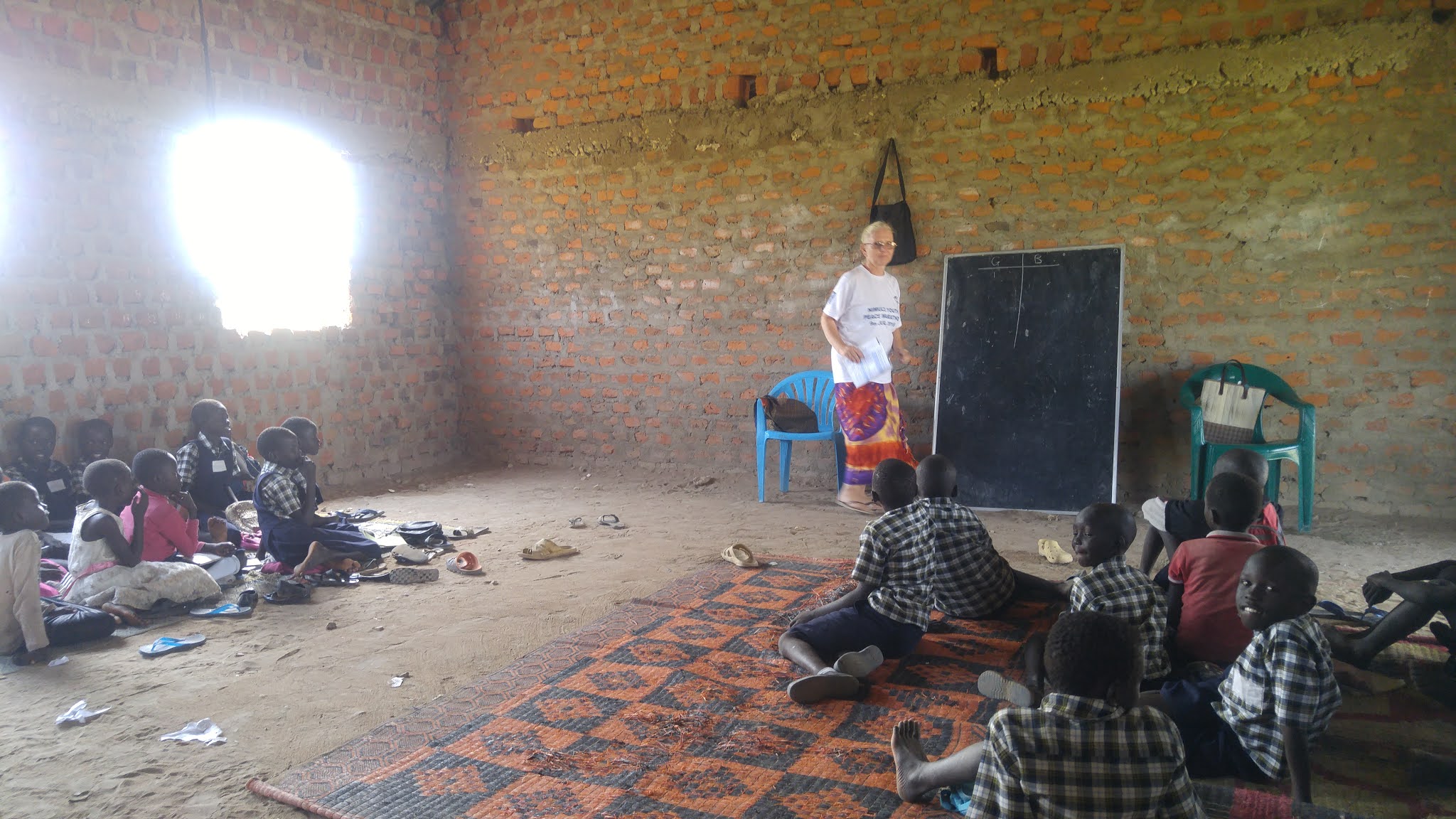
In terms of Cece Primary School, a major hurdle in getting our school ready for the post-closure reopening, is going to be seating arrangements.  As many of you will know from my descriptions of the school, most of our children sit on large mats on the floor.  We only have twenty four desks, which are long and usually seat three or four children each.  None of this will work under social distancing conditions.  Our children when sitting on mats, always crowd together and are difficult to control.  Getting them to stop doing this will be next to impossible, especially for the younger ones.  The twenty four desks should only have one child per desk.

Please can I appeal for funds for desks to enable us to seat our children properly?  I would like to be able to order 250 single seater desks in time for January 2021.  We need to act quickly because it is not possible to order readymade desks here.  An order will have to be placed with a local joiner and metal worker, the joiner for wooden seats and desk surface, and the metal worker for the desk framework and legs.  The manufacturing process can be time-consuming as there is no factory production and everything is made individually.  The cost is estimated at roughly £32 per desk including transport to the school, so this is a major undertaking.  We would really appreciate as much help as possible.  In the event that more funds are given than needed for the desks, the extra money will be used for other Covid-related expenses such as facemasks, disinfectant and soap.

Literacy Campaign

HUMAES and some school staff have been having training from the Civil Society Facility on advocacy.  As a result of this, we have decided to start a lobbying campaign for a national literacy strategy.  This is sorely needed because the South Sudan Curriculum does not include literacy, even though it is mentioned in the General Education Act 2012.  Nor is there any training in literacy at teacher training colleges within South Sudan because they all follow the curriculum.  This is a very serious omission because the illiteracy rate in South Sudan is 84%.  In other words, 21 out of 25 people cannot read.  Almost all professional expertise comes from outside the country as a result, whether foreigners or returning refugees educated elsewhere.

Teaching a Primary 2 class.    We were
having a competition. No windows.  No books.
Ever since I came to South Sudan I have been struggling against this lack of literacy, but it is really not a one-woman task even in one school.  Up until now, I have been the only literacy teacher at Cece Primary School, but this is becoming less and less practical as the school grows.  I am shortly going to hold some literacy training sessions for all our teachers so that they can put literacy into all their lessons.  My own training is not great from a professional perspective, but I do have the experience of my children’s early years at primary school, in which parents were very much involved.  In 2014 I attended a short training course in JollyPhonics, which is a great method for a country almost entirely without books.  I have been teaching literacy ever since. 
Unlike any other school in Nimule, at Cece Primary School we have some early reading scheme books, which are collected for the school by one of our school’s supporters, Hazel Crossley, whenever I return to the UK.  However, they are from different reading schemes and very incomplete.  I also bring back story books to stimulate a motivation to read in the children.  Those of our children who have been in our school since we opened in 2015 without interruption are now fluent and very eager readers of anything in print.  Once a week we have ‘story time’ which is intended to stimulate interest in books, although it also is very helpful in giving the children the confidence to stand up and speak.

I am going to describe what happens in a typical South Sudanese exam room where the children cannot read.  I have witnessed this for myself and can assure you that I am not exaggerating.  The teacher reads the questions to the children.  In some cases, the teacher even writes the answers for them.  If writing by themselves the children randomly copy words from the exam paper in a frantic attempt to pass their exam.  They know that if they do not pass, they will not progress through the school.  Their parents become disheartened with the ever increasing cost of school fees as the children repeat the preceding year several times.  Eventually the parents stop paying, so that their children are forced to drop out of school.  If they are girls they will be married off.  If they are boys they might become child soldiers, criminals or do the most degrading work, such as fetching rubbish from restaurants.  Some become town drunkards and drug-addicts.  These are all common scenarios in South Sudan.  Please continue to support us so that our school and our partner HUMAES can be an instrument in bringing this nightmare situation to an end.

Other news

I am so grateful for the continued generosity of all our donors during this time.  As a result we have been enabled to continue paying our school staff, which helps to keep them on board and with a positive attitude towards our school. 

We have also been able to make doors and windows for the remaining school classrooms.  This was made possible through a large donation from R K Pryor Trust.  This is particularly important because there are a lot of roaming youths who are making use of empty and unsecured schools for their own dubious purposes.  The doors and windows will very soon be fitted and the rooms will be locked.  Securing the classrooms will also help to keep our new desks safe from thieves.

Two of our teachers have been planting fruit trees and shade trees at the school as well as flowers and bushes.  Hopefully these will survive the dry season if they are regularly watered.  The dry season usually starts around late November or early December.

If you are able to make a one-off donation towards buying desks, we would be so grateful.  There is also a need for fencing for the newly planted trees to stop them being eaten by passing cattle.  Please can you continue to support us with regular donations towards salaries. 

As already mentioned, we are deeply grateful for your continued help.  I am happy to send gift aid forms to anyone interested.  My email address is rebeccamallinson1@hotmail.co.uk.  It is also now possible to make donations online through VirginMoney Giving.  Please be aware that it is necessary to put ‘Cece Primary School’ in the comments box, as Opportunity through Education also collects funds for other causes.  Virgin Giving charges a hefty admin fee on large donations, so please send direct to Opportunity through Ed  ucation if you are considering sending over £1,000.

Friday, 24 July 2020

What is going to happen now?


The World Health Organisation said a few days ago that they feared the African continent is on the verge of a great surge in the number of Covid-19 cases.  They gave details of rises of up to 33% for three African countries where testing is relatively reliable.  Based on that, they said that the whole continent is very likely to be in the same state.  This announcement came at the same time as UNICEF advocated for the South Sudanese Government to reopen all schools.  There is a definite conflict of views between these agencies.

Local Covid-19 Facilities

Facemasks made locally drying after being washed.  We have
stopped doing this because too few people would buy them.
Here in South Sudan, there are only two testing facilities across the country, one in Juba and the other here in Nimule.  Juba is the capital city, so are a major priority.  Nimule was chosen because we have the main means of road access into the country, used by the majority of trucks bringing goods to all parts of the country from East Africa.  It is essential that all truck drivers are tested and refused entry if they are positive.  This has been happening under the auspices of WHO.  However, due to the low capacity of the testing machine and low staffing levels, it is only possible to do up to sixty tests each day.  For that reason, tests are only done on priority cases: truck drivers and health workers.  So far six health workers (including a doctor) have tested positive at Nimule Hospital.  As described in a previous blog post, there have been huge delays for truck drivers on both sides of the border while waiting for tests and test results.

There are no local quarantine facilities in Nimule, so those who test positive have to self-isolate if they are asymptomatic or with low-level symptoms.  This is problematic because of local resistance to Covid-19 measures.  The hospital has a small isolation unit for those with symptoms who are awaiting test results and those tested positive who are awaiting transfer to distant areas.  The unit is composed of two leaky tents (it is the rainy season right now).  The water pump has been broken since the beginning of the outbreak and was only fixed last week, so water has been carried from some distance away.  The majority of the hospital staff refuse to work in the isolation unit because of lack of protective gear and also lack of pay.  There are no arrangements for feeding those in the unit, so the NGO representatives regularly do a whip-round out of their own pockets.  Because of these difficulties, the hospital tries not to send people to the unit unless there is absolutely no alternative.

Attitudes in the Community

Most people claim that Coronavirus does not exist.  According to the majority view, it is all a plot by the rich nations working through the NGOs to spoil the lives of South Sudanese.  They point to the fact that the NGOs are paid for their work.  There is a huge resistance to all precautionary measures.  I think this reaction is due to fear, which is causing people to bury their heads in the sand, and also to concerns about survival.  The local community attitudes reflect attitudes across the country. 

Many churches have reopened in direct contravention of Covid-19 regulations.  These churches claim that the government advice comes from Satan and is a way to stop Christianity.  Very large numbers are attending with no social distancing or face masks.

There are many funerals, all attended by large numbers of people over several days, without the least regard for social distancing.  I suspect that Covid-19 plays its part in some of these deaths, but it is impossible to prove this one way or the other due to the low level of testing.  Yesterday I was told that a former teacher from Cece Primary School, quite a young man, has died.

It has been very difficult for areas impacted by closures, which has been a major cause of civil disobedience.  People still need to feed their families and live from hand to mouth, washing dishes for restaurants, fetching water to sell to locals etc.  On a positive note, large numbers of people who previously depended on handouts from the refugee camps in Uganda, start work to produce their own food.  Thankfully there has been plenty of rain. 

Churches, for example, rely on collections to provide for the living expenses of priests and pastors.  Goods are more expensive because previously local people crossed the border and bought their stock at the nearest Ugandan market and resold it in Nimule.  Now, they have to pay truck drivers to bring the goods.  The churches are now disobeying and most people are attending Sunday services.  Bars and hotels are open for business, with crowds of locals coming to watch international football matches on the television.

NGO Activity

Most of the NGOs who were initially involved in the fight against Covid-19 have reached the end of the end of their contracts.  Some may resume if their international headquarters agree, but others are completely finished. The latest and most devastating, is the end of the WHO contract.  From now on there will be no testing of truck drivers at the border.  Trucks can now pass freely. 

HUMAES has worked hard to make people aware of Covid-19 through radio talk shows and moving around the county.  They continue to distribute soap, buckets and locally made face masks, but when they return to check, they often find the buckets empty, the soap gone and everybody close together with no face masks in sight.  Increasingly, they face anger from those they talk to.

Government Agencies

The law enforcement agencies such as police, security and immigration who were initially working together with local government, are now refusing to cooperate and have stopped attending Health Department meetings.  The closure of the border has impacted on corrupt practices, because it has become such a slow process to enter the country, thereby cutting the number of opportunities for illegal demands for payment each day by immigration and customs officials.  Their lack of cooperation is almost certainly because of the lack of opportunities for enrichment.

At a meeting I attended earlier this week, the head of local government told the meeting that police and security are no longer enforcing the regulations.  Some of their chief officers can be seen playing cards, drinking and taking sheesha in all the places where they are supposed to be enforcing the regulations.

The Director of the County Health Department does not know which way to turn in his efforts to curb the virus.  Every day there is more bad news.  Government staff are rarely paid and there has been no money from the central government at all, let alone for Covid-19 activities.  That is in spite of the huge amounts poured into South Sudan.  Even without pay, he works seven days a week in his personal effort to galvanise everybody.  The same applies to the Education Director, who is hard at work on child protection strategies for out-of-school children.

At a meeting of Headteachers, the Acting Town Clerk (the equivalent to a Mayor) said that as nothing can be done from the top, we need to work from the bottom.  He is appealing to all local village chiefs to help in combating the pandemic at local level and join hands to change the situation.  A priority for the Town Clerk and also the Education Department is ensuring the personal well-being of school children who are being neglected and teenagers who are completely out of control, causing a large rise in teenage pregnancies and elopments.  This is starting to be addressed through the local chiefs’ advice to families.

Schools

There is a big debate on what to do about reopening schools.  UNICEF is advocating reopening immediately for the sake of the children’s education.  However, large class sizes, small numbers of classrooms, size of classrooms and inadequate numbers of teachers will make it impossible to socially distance. 

On the other hand, Kenya has led the way by declaring 2020 a ‘dead year’ and will not reopen until the next academic year, which starts in January 2021.  Children in Kenya will all repeat their current year.  This will enable those in the final examination years to have a full year of lessons instead of failing exams which are important for their future.  To me, the Kenyan model makes more sense in South Sudan, as long as we can address the social issues faced by our children in the meantime, which we are trying to do.

Opinions are very much divided on the right way forward.

Conclusion

What a mess.  Although the numbers reported in South Sudan are tiny compared to those in the US or Europe, they give a very inadequate picture because of the lack of testing.  As mentioned the large number of funerals tell a different story.

The economic situation is a huge pressure on people to ignore restrictions and deny the reality of Covid-19.  This in turn leads to further infections, which (if WHO is right) are escalating in any case.
The general atmosphere of lawlessness in South Sudan, which is ongoing, makes matters worse.  Other parts of South Sudan are in an even worse state because of inter-tribal conflict, which at least is not a feature here.

As my youngest daughter once said to me with great passion at the age of five, “Don’t give up!  You must never give up!”  At least the local government is committed, even if they struggle to find support and have no resources themselves.  Our own school partner HUMAES is also very committed.  HUMAES, being a local organization, is not leaving and is looking at other ways to help in the battle against Covid-19.

If you are a religious person, please pray for our very difficult situation.

Wednesday, 17 June 2020

It is good to be human

Some of our children used some wild flowers to
 make the local equivalent of daisy chains to bind
themselves together.  (Before the schools closed
or social distancing came into our lives.)

I have been so sad to hear the news of what is happening in the US and my own country.  We seem to have become barbarians.  First the misery of Brexit, with its racist undertones.  Then Coronavirus to stop people interacting and lose human contact.  Maybe this is what has driven people mad.  Now riots based on the whole racist debate and bringing up all sorts of recent and historical grudges.  Do we all hate each other so much?

I come from London, which has been a cosmopolitan city right back to Roman times.  Throughout my school days and my adult life I have been part of a multi-ethnic society, with friends and work colleagues from all over the world.  Yes, I know there have always been problems of racism, but I have always believed that the more educated the person, the less narrow-minded they are likely to be.  This is certainly true in my own family, where there is a massive class and education gap between my father’s and my mother’s side of the family.  For example, my paternal grandmother finished school at 11 years old to help support her desperately poor family.  I loved her dearly, but even as a small child I was deeply shocked by some of her racist statements.  My mother’s side of the family was well-travelled, well-educated and used to other cultures and did not tend to make that sort of judgement.

Tribalism and racism come from the same narrow mindset of ‘them’ and ‘us’.  This is why I jointly founded a primary school in South Sudan, a country with huge problems of tribalism, extreme poverty and illiteracy.  My co-founders are all from the local Madi tribe, but are relatively well-educated.  They understand the importance of bringing peace to the country and of development to combat poverty.  That is why they asked me to help them start a school for the poorest and most marginalized children in the local community.

At Cece Primary School we have children from fifteen different tribes, some of which have a long history of enmity and genocide between them.  When we hold parents meetings, we almost always have tearful mothers from internally displaced tribes thanking us profusely for accepting their children in our school even though they are from elsewhere in the country and fled to Nimule to escape war.

Here is a short poem, written as a class exercise by some of our pupils for African Child Day two years ago which seems very appropriate right now.

We are all one colour, give us love,
We are all one colour give us peace.
No more fighting, no more war,
No more tribalism.
Children of Africa,
The future of Africa.
Do – Not – Kill – Us!!

I think the whole world needs to learn from our children at the moment.  Otherwise humanity will destroy itself.

Below is a quote from Henri Nouwen, “Caring for the Whole Person”.  I seem to be reading a lot of Nouwen at the moment!

One of the greatest human spiritual tasks is to embrace all of humanity, to allow your heart to be a marketplace of humanity, to allow your interior life to reflect the pains and the joys of people not only from Africa and Ireland and Yugoslavia and Russia, but also from people who lived in the fourteenth century and will live many centuries forward.  Somehow, if you discover that your little life is part of the journey of humanity and that you have the privilege to be part of that, your interior life shifts.  You lose a lot of fear and something really happens to you.  Enormous joy can come into your life.  It can give you a strong sense of solidarity with the human race, with the human condition.  It is good to be human. 

Tuesday, 9 June 2020

I never thought I could be a fundraiser


I have been going through the school’s finances over the years since we began and can only gasp with astonishment at how far we have come.  In 2015 we started very small, with 60 children in a loaned building.  Now we have 247 children in our own purpose-built school and a regular income, which is generally fairly stable.  All this has been done through your help.  First, friends and relatives, then churches and charities started to help too.  The circle has widened through personal contact, not through NGO lobbying.  Most remarkably as I have very little opportunity to visit the UK, almost all my contact has been over the internet, which is very unreliable here in South Sudan.

Our girls' football team just before
winning their first ever match last November.
Cece Primary School owes its continued existence to all of you who have donated to the school and encouraged me to persevere.  I have always had a great antipathy to money, which has made me a most unlikely fundraiser and makes the results all the more surprising.

It is true that right now we are on hold and the school is shut.  The deaf children have also had to return home.  However, eventually this will change.  We will go back and with great relief get cracking again to help our children out of the grinding poverty of their backgrounds, hopefully changing the mindsets of the local community along the way so that children are no longer treated as the lowest thing that crawls, but as valued members of their families. 

Through your help the teachers and cooks continue to be paid.  This will help motivate them to remain loyal to our school rather than finding permanent work elsewhere, which is very important in this difficult time when prices are escalating and food is scarce.  It is also very important that when schools finally reopen, our teachers are able and ready to teach again.  All our staff will also maintain a positive attitude to the school.

Our deaf children on their way home after the
closure of their schools due to Coronavirus.
I can remember in 2013, when Pope Francis had recently taken office, he spoke out against NGOs (including Catholic ones) who broadcast money for their projects from on high with a motivation of publicizing their own greatness.  I have seen for myself here in South Sudan, how short-term their vision can be and how difficult it can be for local people to access the much publicized help.  A lot of the funds get lost along the way due to bureaucratic processes, lack of supervision and corruption.  The money the NGOs give is taken from across the world, often without the expressed wish of those paying, as it comes from governments using their people’s taxes.  There is no care for the individual, just a lot of faceless numbers, with an occasional very sad ‘human story’ to give a feel-good feeling.  It is all about how many millions of children across the world receive this, that or the other.  On the surface it looks humanitarian, but there is a lack of love and care.  The help given is rarely of a type to bring South Sudan into a position of helping itself, but of continuing dependency.

A prime example of this cynical approach is the Girls Education South Sudan (GESS) project, funded by the EU and UKAID.  We are told that the purpose of this project is to encourage teenage girls to remain in education and avoid early marriage.  This is a serious issue in South Sudanese society, driven by poor quality, expensive education, the greed of families for large bride-prices, and the misery of teenage girls in insupportable family circumstances where they are frequently beaten and expected to work like slaves from morning to night.  At school these girls under-perform because they are always late, dog-tired and miserable.  Not surprisingly, a lot of these girls run away or look for a man to take them away from their home situation.  The result is very high teenage pregnancy rates and girls jumping out of the pan and into the fire by becoming neglected or battered wives of polygamous men. 

GESS believes that giving a small sum of money to each girl from Primary 5 upwards will encourage them to remain in school.  Is that really the answer to the situation I have described?  How can it be?  It just makes GESS feel able to report the huge number of girls reached.  The amount of money is only 2,200 SSP per girl, around $8.  It will maybe buy some stationery and a couple of packs of sanitary pads.  That money is nothing compared to school fees or bride-price, so will not motivate parents to keep the girls in school.  The answer to the problem is not money but society change, which is much harder to achieve. 

The problems of teenage girls are addressed at Cece Primary School by setting up a girls’ protection workshop, with a supervising female teacher and peer mentors.  These mentors raise any problems faced by the girls so that the school can talk to parents and local chiefs to help address the individual girl’s situation.  This approach does not take money.  Instead it takes a view that each child matters.  When we show love to our children they will respond, even if not immediately.

I recently read a book called A Spirituality of Fundraising by Henri Nouwen.  I wanted to know how Henri Nouwen could possibly see fundraising as something that has a religious aspect.  Ever since starting the school I have been very worried by talking about or dealing with money; I try to live a religious life and feared the financial side as bringing me down.  I can strongly recommend this book.  When I read it, I realized that without knowing it, I was in fact already following some of Nouwen’s recommendations.  I am now going further by talking to you about the role of supporters as Nouwen sees it, and as I see it too.

Nouwen’s philosophy of fundraising is to create a community of supporters and recipients all in relationship with each other.  In religious terms, each donor or supporter and each recipient should be valued for themselves as children of God’s Kingdom.  The community (in this case, the children, their families and the school staff) is God’s Kingdom on earth.  By donating or interacting in any other way, supporters become part of that Kingdom.  It is supposed to be a community of love.  The fundraiser is a go-between facilitating that community.

I know that some of you are not religious and may find this post difficult.  I apologise if you are offended.  In previous posts I have tried not to rub people’s noses in my religious views while at the same time being honest about the motivation for my work here, whether with the school or the deaf children.

I believe that all of you, our supporters, are passionate about helping the children of our school and also the deaf children going to school in Uganda.  Let us work together.  I know that the distance is huge between the UK and South Sudan, but let us feel our closeness in spirit.

Love is something very thin on the ground in both the UK and in South Sudan right now.  Please continue to help our mission to our children to be a light in the darkness of racism, isolationism, corruption and abuse all of which affect both our countries.

Friday, 24 April 2020

Limbo


Here in Nimule we continue in limbo, waiting for the end of the Covid-19 crisis.  We are fortunate in that there are very few confirmed cases in the whole country – only 5, and no deaths so far.  For a change it is good to be at the bottom of the league tables.  I am very thankful for that as there are also very poor medical facilities to deal with even normal health problems, let alone an epidemic of any kind.

The main hazard for Covid-19 is seen as the truck drivers who bring supplies from other African countries such as Kenya, Tanzania and Uganda, which all have far higher rates of infection than South Sudan.  All these pass through our town on their way to Juba.  Our main road is the only tarmac road in the country, so it is a very important artery into the country.  The border is completely closed apart from these trucks.


Due to the awareness of the risk of these travelling drivers spreading the contagion, they are tested at every border they come to.  They are also no longer allowed to have any co-driver with them, at least travelling through South Sudan.  That must surely carry a risk of over-tiredness and resulting accidents, although I have not seen any proof of that.

Over the past two days, the testing has become yet more rigorous and long-winded so that the queue of trucks for the border is now huge and goes right through the whole town, passing my own home.  The drivers need to eat, so they have no choice but to buy food from the local fast food stalls, which must create a risk of infection as there is little access to face masks here.  One of the food stalls is in the foreground of the photo on the right.

This is not the first time truck drivers have suffered to carry out their jobs.  During the height of the war, when all the neighbouring towns to Nimule had been destroyed, the soldiers were looting and removing everything from the desolate homes, schools, shops and churches.  They then flagged down passing trucks, and forced the truck drivers at gun point to carry the loot to Nimule to be sold in the streets.  My heart used to bleed for them, as I watched the stolen goods unloaded.

Now they are risking their lives again to carry food and other necessities to South Sudan, with all the local people fearful and sometimes even downright hostile towards them as potential carriers of Covid-19.

For those who pray, please pray for these drivers and their families who rely on this dangerous work for survival.

Thursday, 9 April 2020

What are we doing at this difficult time?


Our school started during the civil war in 2015 and has managed to grow and develop throughout five years of war with your generous support.  Even at one point in 2016 when all other primary schools closed completely, we kept going.  I am very proud of that record.  The war is now officially over, but are we going to be beaten by Coronavirus?  I sincerely hope not.  We are determined to keep going, even though at the moment we have no way of teaching. 

Tailor cutting our school shirts.
Our teacher-in-training Mohammed has come back to Nimule with course-work and a project to carry out, under the supervision of his course tutors, who are in touch with him through Facebook.  As part of this, he has just started an agriculture project for a handful of our school children in our school compound.  Ten is the maximum number for any gathering according to the government so we are being very careful not go over this number.

In the first two weeks that our school has been on hold, I have typed up all our exam papers ready for the end of term.  It now seems likely that we will have to adjust so that the exams are held whenever we are finally allowed to go back to normal.

Our new kitchen
Uniforms have been made for those children without uniforms, but we cannot distribute them yet.  The new kitchen is ready, but nobody will be cooking in it for a while.

I have done a major clear-out of our school storeroom and it is now far more organized than previously.

Rather than sitting twiddling my thumbs and going slowly off my rocker, I am starting to do some ad-hoc teaching of the young children who live in my home compound.  I have some resources which are not used at school as they are not suitable for large numbers.  The first morning, for instance, I taught the children to play dominoes.  Their number recognition is very poor, so this was a big challenge for them, especially as I was teaching them in English, not their mother tongue.  The lessons can continue indefinitely as they have a lot to learn! 
The children do some colouring and practise
writing the letter S at the same time.

We continue to plan for our building work, but at the moment cannot access the funds.  It would be very helpful if people can help us to fundraise even so, so that once things return to normal we will be able to get cracking. 

I have heard a very sad story of staff laid off in Kenya by major employers such as Kenya Airways, in complete breach of their rights as employees.  We have no intention of treating our staff like that, so it is important that we continue to pay them throughout this crisis.  Comfortingly, most (but not all) of them are able to grow food themselves and the weather is rainy, however it will be some time before there is anything to harvest.  Making sure our staff, teachers, cooks and guards are not forgotten is also a good way to ensure their loyalty to the school.

I am happy to send gift aid forms to anyone who is able to help with the construction costs of the new classroom block, or with regular donations so that we can pay staff salaries regularly.  My email address is rebeccamallinson1@hotmail.co.uk. 

It is also possible to make donations online through Virgin Money Giving.  Please be aware that it is necessary to put ‘Cece Primary School’ in the comments box, as Opportunity through Education also collects funds for other causes.  Virgin Giving charges a hefty admin fee on large donations, so please send direct to Opportunity through Education if you are considering sending £1,000 or over.

Thursday, 26 March 2020

We have peace at last!


After six and a half years of civil war, South Sudan has declared peace and has sworn in a new ‘unity’ government, which is now just over a month old.  It is called a unity government because it consists of all the warring parties from the conflict.  It remains to be seen how well this will work, but at least at the moment, hopes are high.  This is causing a lot of refugees to return home, including trained teachers.

In a recent post, I described the difficulties we have faced with teachers.  I am happy to say that we have recently appointed several new teachers to replace those who have left.  The majority of the new teachers are trained and have considerable experience teaching in Uganda.  One is newly trained on a similar course to the Solidarity with South Sudan one, where Mohammed is studying.  This influx of teachers has transformed the teaching experience for the children. 

Coupled with the arrival of the new teachers, we have received a delivery of new textbooks using the New South Sudan Curriculum from the Ministry of Education.  They are very much better than the old books, but at the moment are only for Primary 1, 3 and 5.  We have been promised that the books for Primary 2, 4 and 6 will arrive, but we don’t know exactly when yet.  The new books include more interesting lessons with hands-on activities.  The only difficulty now is the need to find enough scissors, colours and a regular supply of paper and other stationery for the classes.

Another piece of good news is that HUMAES (our local partner NGO) has started a pilot project in our school to help our older girls with their particular child protection issues.  These difficulties have been mentioned in a previous post.  They have organized our girls of 12 years old or older by class, with a peer mentor in each class and overseen by one of our teachers.  The whole group meets once a week in the lunch hour and learns about various important issues affecting them, such as bodily hygiene, menstruation, sexual abuse, draconian punishment etc.  If a girl is suffering any sort of abuse at home, she can discuss the problem with the teacher-in-charge or the peer mentor in her class.  In less serious cases, the teacher will talk to the girl’s family and try to resolve the problem.  If necessary, the neighbours and local chief will be called to work together to provide back-up.  So far we have had one case, which was peacefully resolved with the help of the neighbours.  This is not a model which I can imagine being successful in Europe, but in a tribal society (where there is no concept of nuclear families) it is an acceptable approach.

Several weeks ago, gale force winds struck Nimule.  Our school kitchen collapsed completely, so that our poor cooks were left cooking in the blazing sun.  By contrast, one day we had heavy rain throughout the school day, so that the cooks were completely unable to provide food for the children.  We have just rebuilt the kitchen using the old foundations and leftover building blocks from previous construction work.  The new kitchen is now finished.    

This emergency building work caused us to raid the funds allocated for other things, particularly money intended for uniforms for our new children.  However, we have recently received some donations which are enabling the tailors to start work, while the school is not operating.
Several donors have quite spontaneously sent large donations.  Thank you so much for thinking of our school and helping us so much.  This money will be used to start on the construction of our last classroom block, which will complete the primary school classrooms.  The only problem is that the border with Uganda is now closed so we cannot access building materials.  This means that an immediate start is not possible.

I am happy to send gift aid forms to anyone is able to help with the construction costs of the new classroom block, or with regular donations so that we can buy school necessities and pay staff salaries regularly.  My email address is rebeccamallinson1@hotmail.co.uk. 

It is also possible to make donations online through Virgin Money Giving.  Please be aware that it is necessary to put ‘Cece Primary School’ in the comments box, as Opportunity through Education also collects funds for other causes.  Virgin Giving charges a hefty admin fee on large donations, so please send direct to Opportunity through Education if you are considering sending £1,000 or over.